
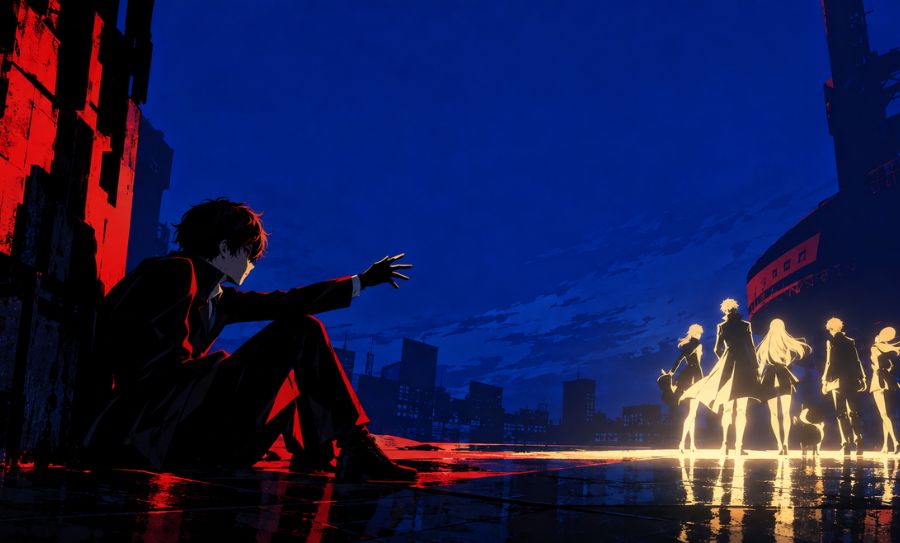
How Video Games Portray Depression Better Than Most Media
Most stories about mental health struggle with the same problem: they treat recovery as an individual act of willpower. A character hits bottom, has one private epiphany, and comes out the other side changed. It's tidy. It's cinematic. And for a lot of people, it doesn't match how depression actually works.
Video games — specifically the character-driven JRPGs that dominate discussions about how video games portray depression — tend to get this wrong less often than most other media. Not because the genre is inherently more thoughtful, but because its core mechanics accidentally model something closer to the truth: recovery isn't something you do alone. It's something that happens with people.
Why Party Systems Aren't Just Mechanics
Take the Persona series as the clearest example. Characters in Persona don't get stronger through isolated effort. They level up through relationships — the Social Link and Confidant systems are literally built around spending time with people, being honest with them, and letting that honesty change you.
This isn't an accident of game design. It's a structural metaphor. In Persona, characters who are struggling — with grief, with shame, with numbness — don't start healing the moment they decide to. They start healing the moment someone else refuses to let them carry it alone. The party system isn't just a battle mechanic. It's the game's thesis statement about what recovery actually requires.
That's a meaningfully different message than "just push through it." It's closer to: you don't have to fix this by yourself, and trying to is often part of what keeps people stuck.
Makoto's Arc as a Case Study
One of the clearest examples of this in practice is Makoto's arc in Persona 3 Reload. He begins the story detached — not dramatically nihilistic, just quietly indifferent to whether he lives or dies. Nothing reaches him. And the game doesn't rush him out of that state.
What changes him isn't a single dramatic event. It's accumulation — small moments, people getting closer, conversations that stick, reasons to stay one more day. By the time Makoto is willing to make the ultimate sacrifice, it isn't because he's given up. It's because, for the first time, staying alive actually meant something to him. The tragedy of his ending isn't just the loss — it's that he finally understood what life was for, right before he had to let it go.
That arc resonates precisely because it mirrors how connection functions as a genuine intervention against numbness, not just a nice narrative beat.
Interrupting the Lie, Not Fixing the Problem
There's a specific phrase worth sitting with here: connection doesn't fix depression, it interrupts the lie depression tells you — that you're on your own. That distinction is what separates thoughtful portrayals from shallow ones.
Games that get this right don't pretend friendship cures mental illness. They show characters who are still struggling, still relapsing, still carrying real weight — but who are no longer carrying it in isolation. That's a far more honest depiction of what support actually does. It doesn't erase the pain. It makes the pain survivable.
Why This Representation Matters
For a huge number of players, these stories aren't just entertainment — they're one of the few places media reflects back a feeling that's hard to articulate elsewhere: the sense of being fundamentally on your own inside your own head. When a game gets that portrayal right, it doesn't just tell a good story. It gives players language for something they've felt but couldn't fully name.
That's a large part of why franchises like Persona have built such devoted communities around their emotional writing. It's not just the combat systems or the aesthetic. It's that the games are, quietly and consistently, saying something true about what it takes to keep going.
The Bigger Picture
Video games will probably never be praised the way literature or film are for handling mental health with nuance — the medium still carries an outdated reputation as pure escapism. But the best character-driven RPGs are doing something a lot of "serious" media still struggles with: showing that healing isn't a solo act of willpower, it's a collective one.
If a story ever made you feel less alone in something you were struggling with, it did exactly what it was supposed to do. The question worth asking isn't whether video games can portray depression well. It's why more media hasn't learned to do it the way games already have.





Deja una respuesta